A phrasal verb is a verb plus a small word such as up, out, off or on that together mean something new. Give and up are easy words; give up (stop trying) is a new item you have to learn on its own. Native speakers use phrasal verbs all the time in speech, films and emails, which is why they feel hard: the meaning is often not in the parts.
The good news is that a small set does most of the work. Below are 40 common ones, grouped by topic, each with a short meaning and an example you can reuse.
Daily life
| Phrasal verb | Meaning | Example |
|---|---|---|
| get up | leave your bed | I get up at seven on weekdays. |
| wake up | stop sleeping | The noise woke me up at three. |
| put on | dress in something | Put on a coat, it is cold. |
| take off | remove clothes; leave the ground | Take off your shoes at the door. The plane took off late. |
| turn on / turn off | start or stop a device | Can you turn the light off? |
| pick up | lift; collect someone | I will pick you up at the station. |
| look after | take care of | She looks after her little brother. |
| run out (of) | have none left | We have run out of milk. |
| eat out | eat at a restaurant | We eat out on Fridays. |
| hang out | spend free time | We hung out at the park all afternoon. |
Work and study
| Phrasal verb | Meaning | Example |
|---|---|---|
| find out | discover information | I found out the meeting was moved. |
| look up | search for in a reference | Look the word up in a dictionary. |
| figure out | understand after thinking | I can’t figure out this form. |
| fill in | complete a form | Please fill in your name and address. |
| hand in | give work to a teacher or office | Hand in the essay by Monday. |
| set up | arrange; start | She set up her own company. |
| carry out | do a task or study | The team carried out a survey. |
| put off | delay | Don’t put off your homework. |
| catch up (with) | reach the same level | I missed a week, so I need to catch up. |
| go over | check or review | Let’s go over the plan again. |
People and feelings
| Phrasal verb | Meaning | Example |
|---|---|---|
| get along (with) | have a good relationship | I get along well with my flatmate. |
| look forward to | feel happy about something coming | I look forward to hearing from you. |
| cheer up | become or make happier | This song always cheers me up. |
| calm down | become less upset | Calm down and tell me what happened. |
| get over | recover from | It took weeks to get over the flu. |
| put up with | accept something unpleasant | I can’t put up with the noise any more. |
| take after | look or act like a parent | He takes after his mother. |
| count on | depend on | You can count on me. |
| give up | stop trying; stop a habit | She gave up sugar last year. |
| show up | arrive, often late or unexpected | He showed up an hour late. |
Plans and problems
| Phrasal verb | Meaning | Example |
|---|---|---|
| call off | cancel | The match was called off because of rain. |
| come up with | think of an idea | We came up with a better name. |
| turn down | refuse; lower the volume | She turned down the job offer. |
| break down | stop working | The car broke down on the motorway. |
| work out | find a solution; exercise | It all worked out in the end. |
| sort out | fix or organise | I need to sort out my papers. |
| come across | find by chance | I came across an old photo. |
| end up | finally be in a place or situation | We ended up staying until midnight. |
| look into | investigate | The manager will look into it. |
| carry on | continue | Carry on, I’m listening. |
Separable or not: where the object goes
The hardest grammar point is word order. Phrasal verbs fall into three groups:
- Separable. The object can sit in the middle or at the end: turn off the TV or turn the TV off. With a pronoun (it, them, her) it must go in the middle: turn it off, never turn off it. Examples: turn off, pick up, look up, fill in, put off, call off.
- Inseparable. The object always comes after the particle: look after the kids, look after them. Examples: look after, get over, come across, count on, look into.
- No object. The verb stands alone: the plane took off, he showed up, the car broke down.
Three-word verbs such as put up with, look forward to and come up with never split. Note that look forward to is followed by a noun or an -ing form: I look forward to seeing you, not to see you.
A good dictionary marks the type. If you are not sure, put the object at the end with a noun and you will be right more often than not.
One verb, several meanings
Many phrasal verbs have more than one meaning, and the context tells you which. Pick up can mean lift a box, collect a friend, learn a language without study (I picked up some Spanish) or answer the phone. Take off is both removing a jacket and a plane leaving the ground. Learn the most common meaning first and add the others when you meet them in a real sentence.
How to learn phrasal verbs so they stay
Lists like the one above are a starting point. What makes a phrasal verb stick is meeting it again, in context, before you forget it.
- Learn the whole chunk with an example. Remember run out of milk, not run out = have none. The example carries the grammar and the preposition.
- Group by topic, not by particle. Lists of every verb with up look tidy but are easy to mix up. Topics like the ones above match the moments you will need them.
- Say a sentence about your own life. I always put off my taxes is more memorable than any textbook line.
- Review on a schedule. Look at a new verb again the next day, then a few days later, then a week later. Each review takes seconds.
- Notice them. Once you know end up, you will hear it in every series you watch. That free exposure is what makes it automatic.
Expect to confuse similar ones (put off and put out, look up and look up to) for a while. That is normal and fades with use.
What this list will not do
Forty verbs are a foundation, not fluency. Some common phrasal verbs have regional flavour (queue up is very British), and slang ones change fast. Formal writing, such as an IELTS essay or a report, often reads better with a one-word verb: postpone rather than put off, investigate rather than look into. Use phrasal verbs freely when you speak and with care when you write formally.
Practise them with WordHabit
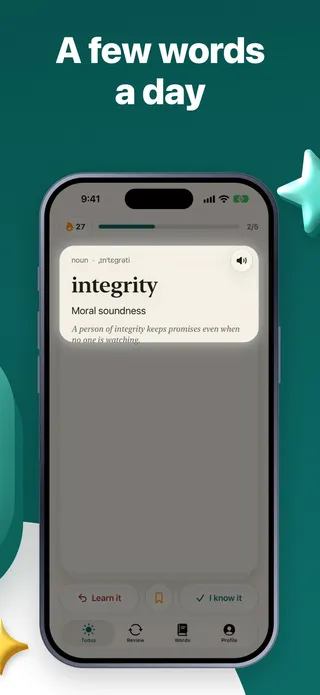
WordHabit on iPhone has an Idioms & Phrasal Verbs list of 120 items, starting with many of the verbs above. Each one comes with a plain definition, an example sentence and its sound, and the app brings it back after 1, 3, 8 and 22 days so it moves into long-term memory. The first 100 words of every list are free.
Not sure about your general level? Take the free vocabulary quiz or read CEFR levels explained.