The Academic Word List (AWL) is a list of 570 word families that turn up again and again in university writing, whatever the subject. Words such as analyse, concept, data, factor, significant and theory are in it. It was compiled by Averil Coxhead at Victoria University of Wellington and published in 2000, and it is still one of the most used tools in academic English courses.
The idea is simple. If you already know everyday English, the words that block you in a textbook or journal article are not rare technical terms (those get explained) but general academic words that no one explains. The AWL collects those.
How the list was built
Coxhead put together a corpus of about 3.5 million words of academic writing from four areas: arts, commerce, law and science, each split into several subjects. A word family made the list if it:
- was not among the 2,000 most common English word families (the General Service List), so everyday words like make and house are out;
- appeared often across the whole corpus; and
- appeared across many subjects, not just one field.
That last rule matters. Molecule is frequent in chemistry but rare elsewhere, so it is not on the list. Hypothesis is used across disciplines, so it is.
Word families, not single words
The list counts families: a headword and its related forms. The family analyse includes analysis, analyst, analytic, analytical, analytically and the American spelling analyze. Learning a family means knowing how the forms change and which one fits where:
The analysis shows a clear trend. (noun) We analysed the results. (verb) She has an analytical mind. (adjective)
Many essay mistakes come from the right word in the wrong form, such as the significant of the results, so practise the family, not only the headword.
The 10 sublists
The 570 families are grouped into ten sublists by frequency. Sublist 1 holds the 60 most frequent families, sublist 2 the next 60, and so on; sublist 10 has the last 30. Sublist 1 alone appears far more often than sublist 10, so work through them in order.
A taste of sublist 1:
| Word | Typical use |
|---|---|
| analyse | analyse data, a text, a problem |
| approach | a new approach to the problem |
| assess | assess the risk, assess students |
| concept | the concept of justice |
| define | clearly defined goals |
| evident | it is evident that… |
| factor | a key factor in success |
| interpret | interpret the results |
| research | carry out research on… |
| significant | a significant increase |
| theory | in theory; test a theory |
| vary | prices vary from region to region |
How much it covers
In Coxhead’s corpus, the AWL accounted for about 10 % of all the words in academic texts. That sounds small, but it adds up fast: together with the 2,000 most common families, a reader knows close to 90 % of the words on a typical page. Research on reading suggests that comfortable understanding needs around 95 to 98 % of words known, so the AWL closes a large part of the gap. Our guide on how many words you need to be fluent explains these coverage figures.
Who it is for
- Students about to study in English, at university or on a foundation course.
- IELTS Academic and TOEFL candidates. Reading passages draw on these words, and using them correctly lifts the lexical score in writing.
- Professionals who read reports, research or policy documents.
If your English is still below B1, start with the most common everyday words first. The AWL assumes you know them. See CEFR levels explained for what each level means.
A practical way to learn it
- Check what you know. Read through sublist 1 and mark each family know well, recognise or new. Most B2 learners already recognise a good part of it.
- Learn in small sets. Ten families a day is plenty. For each, note the forms you need, a collocation (conduct research, a significant increase) and one example sentence.
- Review before you forget. Look again the next day, then after a few days, then after a week. Short, spaced reviews beat one long session.
- Read in your field. Pick one article a week from your subject and underline AWL words. You will see the same ones constantly, which is the point of the list.
- Write with them. Paraphrase a paragraph you read, using two or three new words. Use beats recognition.
Limits to keep in mind
The AWL is based on writing from the late 1990s and leaves out words that are frequent in only one field, so you still need the vocabulary of your own subject. It is a reading list first: knowing hence or thereby does not mean you should use them in every sentence. Some newer lists, such as Gardner and Davies’ Academic Vocabulary List (2014), use a larger corpus and do not depend on the old General Service List; if you are building a course, compare them.
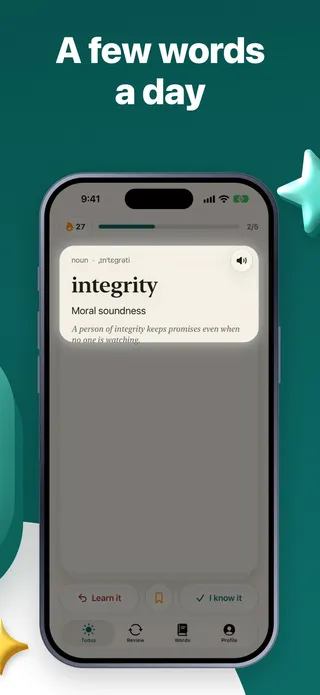
Practise academic words with WordHabit
WordHabit on iPhone has an Academic English list of 120 words, such as derive, infer, hypothesis and methodology, and an IELTS & TOEFL list of 600. This list is the app’s own selection, not the AWL itself, and it covers the words students most often need for reading, lectures and essays. Each word comes with a definition, an example and its sound, and returns for review after 1, 3, 8 and 22 days. You can also browse the free IELTS and TOEFL vocabulary list on this site.